
New Product Introduction: Timeline and Best Practices
Product launches succeed when engineering leaders balance speed with disciplined process controls. A structured new product introduction (NPI) process enables companies to get products to market faster while maintaining quality standards and cost targets at every phase gate.
The framework embeds risk management and validation checkpoints directly into development cycles, creating predictable launch timing that protects product integrity and competitive advantage.
When market windows shrink and product life cycles compress, the ability to move from concept to volume production with minimal adjustments determines which companies capture early market share.
Why a Disciplined NPI Process Is a Competitive Advantage
A disciplined NPI process is a strategic priority that delivers predictable timelines, controlled costs and superior quality for complex electronics. Speed matters because companies that launch first in a product category capture disproportionate market share before competitors can respond.
A structured product introduction strategy creates a competitive advantage by enabling faster market entry while maintaining the technical rigor that ensures long-term product reliability.
How Time to Market Directly Impacts Profitability
Launch delays cut directly into lifetime profitability, with revenue and margin losses compounding as schedules slip. Shorter time-to-market for products reduces development costs by limiting resources during extended engineering cycles while enabling earlier access to customer revenue.
The advantages of speed become particularly valuable in shrinking product life cycles, where speed as a competitive factor determines market share distribution across an entire category. Companies that can shorten the product development timeline without sacrificing quality capture premium pricing windows and establish brand positioning before competitors can launch alternative solutions.
The Hidden Costs of a Disconnected NPI Process
Many life cycle costs lock in during the design phase. Disconnected NPI efforts can trigger budget overruns through expensive rework cycles, excess inventory accumulation and extended lead times that delay revenue recognition.
Field failures from inadequate validation damage brand reputation and erode customer confidence, creating costs that persist long after the initial launch. Engineering teams working across fragmented vendor networks face communication breakdowns that multiply error rates and extend troubleshooting time.
Errors in the design phase convert what should be predictable development into reactive problem-solving that consumes resources and delays market entry.
The Lectronix NPI Step-by-Step Framework
A proven phase-gate NPI framework moves electronics products from design release to full-scale production while minimizing risk at each transition. Each phase includes clear deliverables, defined timelines, risk gates and resource assignments that maintain continuity from prototype to mass production.
The structured approach to NPI best practices ensures cross-functional teams remain aligned on technical requirements and schedule commitments throughout the product development timeline.
Phase 1: Concept Design and Feasibility
A dedicated program manager joins customer teams at design release to ensure complete documentation, tooling plans and test strategies are in place before hardware development begins.
Engineering teams perform detailed Design for Manufacturability (DFM) analyses that identify potential production constraints. They then create the Product Requirements Document (PRD) that locks specifications and conduct market analysis within four to eight weeks.
Phase completion confirms material choices, component availability and manufacturability requirements before committing resources to prototype builds.
Phase 2: Development and Prototype Validation
In-house hardware, software and mechanical engineering teams build functional prototypes using a complete Bill of Materials (BOM) and Computer-Aided Design (CAD) models.
End-to-end electronic product development capabilities enable rapid iteration cycles across eight to 12 weeks, with multiple design reviews ensuring alignment between customer requirements and technical implementation.
An Engineering Validation Test (EVT) and reliability testing confirm the product meets all technical and quality gates before advancing to production validation.
Phase 3: Production Validation and Process Controls
Suppliers undergo capability audits and sample validation, and manufacturing processes are developed and documented to ensure repeatability at scale. A Design Validation Test (DVT) freezes the design by confirming all specifications perform as intended. A Production Validation Test (PVT) proves the product can be built reliably during a 6- to 10-week phase.
Pilot builds establish process capability metrics, quality plans and yield targets that define acceptable performance ranges for repeatable manufacturing operations.
Phase 4: Manufacturing Ramp-Up and Launch
Production scales over eight to 16 weeks through line balancing and process monitoring that deliver steady-state output. Turnkey manufacturing services integrate functional testing and quality control at every production stage, ensuring target cost and quality levels remain stable as volumes increase.
The program manager oversees the full transition to ensure zero loss of continuity into volume manufacturing, maintaining technical documentation and process knowledge throughout ramp activities.
Core Pillars of a Successful Electronics Launch
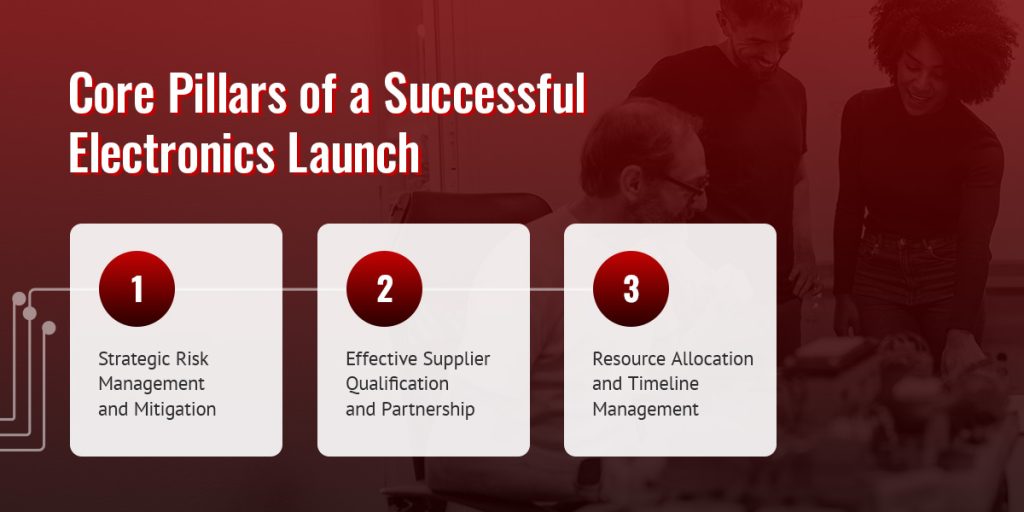
Successful electronics launches rest on three integrated pillars within the product introduction strategy that ensure speed, quality and cost control across development and production phases.
Strategic Risk Management and Mitigation
Risks are identified at every phase-gate review using formal risk matrices and Design Failure Mode and Effects Analysis (DFMEA) that quantify potential failure impacts. Early mitigation strategies and regular Key Performance Indicator (KPI) tracking keep programs on schedule by turning potential problems into actionable items before they affect timelines.
Cross-functional status updates maintain visibility across engineering, supply chain and manufacturing teams, ensuring resource allocation adjusts dynamically as program requirements evolve.
Effective Supplier Qualification and Partnership
Suppliers are qualified based on their production capacity, quality control systems and technical competence before purchase orders are issued. Sample validation and ongoing performance scoring create accountability that drives continuous improvement in delivery reliability and component quality.
Close collaboration with qualified suppliers secures reliable material flow and reduces lead times. Solid supplier relationships also enable cost optimization initiatives that improve margins without compromising quality standards.
Resource Allocation and Timeline Management
Cross-functional teams receive clear phase plans with assigned owners and realistic timelines that account for validation cycles, supplier lead times and process development requirements. Weekly progress reviews and real-time tracking tools maintain alignment while surfacing constraint issues before they affect the schedule.
Leveraging proven building-block technologies accelerates development by reusing validated designs and processes, reducing risk while speeding up the product launch timeline.
Evaluating an NPI Manufacturing Partner
Engineering leaders who outsource NPI need practical criteria to select manufacturing partners capable of executing complex electronics programs. Successful companies choose partners based on proven process capability and execution track records.
Key Criteria for Partner Selection
Leading manufacturing partners maintain in-house design review, prototype validation and processes that eliminate handoff delays between engineering and production teams. Scalable production capacity ensures that facility limitations or equipment availability don’t constrain the schedule.
Strong on-time delivery performance supported by IATF 16949 and ISO 9001 quality systems demonstrates the process discipline required to maintain schedule commitments and quality standards simultaneously.
Questions to Ask a Potential Partner
Evaluating partner capabilities requires direct questions about process rigor and execution experience. Ask potential suppliers the following:
- How do you perform DFM and DFT analysis during the design release phase? Partners should demonstrate structured review processes that identify manufacturability issues before prototyping begins.
- What is your average timeline from prototype validation to full production ramp-up? Realistic timelines reflect process maturity and resource availability, while overly aggressive estimates signal a potential schedule risk.
- How do you qualify suppliers and manage supply-chain risks throughout the NPI process? Supplier qualification depth directly impacts component quality and delivery reliability across production volumes.
- Can you share recent case studies of similar electronics programs you have supported before? Relevant experience in comparable product categories reduces learning curves and execution risk.
Launch Your Next Product With Lectronix, Inc.
Disciplined NPI execution delivers measurable advantages in speed, cost containment and product reliability across every phase from concept validation through manufacturing ramp-up. Choosing the right partner is a critical part of speeding up time-to-market and capturing market share before competitors.
Lectronix, Inc. integrates engineering, prototyping and production under one U.S.-based operation, eliminating the handoff delays and specification drift common in programs with multiple vendors. Our dedicated program managers maintain continuity throughout, ensuring zero loss of institutional knowledge during phase transitions. We protect market windows by accelerating development cycles without sacrificing quality or creating technical debt that surfaces after launch.
Request a quote for expert guidance on NPI best practices or tailored solutions that turn electronics concepts into market-ready products.